

When a loved one’s needs begin to outpace what the family can manage alone, the question almost always comes up: should we bring care into the home, or is it time to consider a nursing home? There’s no single right answer — it depends on your loved one’s medical needs, personal preferences, available family support, and financial situation. What families need is a clear, honest framework for thinking it through. This guide compares in-home care vs. nursing home care across the dimensions that matter most: what each option provides, what it costs, how Medicare and Medicaid treat each one, quality of life considerations, and a practical decision framework to help your family find the path that’s right for your situation.
What Each Option Actually Provides
In-Home Care
In-home care brings professional support into your loved one’s own home — allowing them to remain in a familiar environment, maintain their daily routines, and stay connected to their community. It’s not a single service but a spectrum, ranging from a few hours of companion care per week to around-the-clock live-in support.
- Non-medical companion and personal care — Help with bathing, dressing, grooming, meal preparation, medication reminders, light housekeeping, and companionship. Provided by home care aides; typically arranged through a licensed home care agency.
- Skilled home health care — Medical services in the home — nursing visits, physical therapy, occupational therapy, wound care — ordered by a physician and provided by licensed clinical staff from a Medicare-certified home health agency.
- Live-in and 24-hour care — For those who need constant supervision but prefer to remain at home. Live-in caregivers reside in the home; 24-hour care uses rotating shifts of multiple caregivers.
- Hospice care at home — Comfort-focused end-of-life care provided by an interdisciplinary team in the patient’s home, covered by Medicare’s hospice benefit.
In-home care works best when care needs are moderate, the home environment is safe and manageable, and family support is available to supplement professional care. It becomes harder to sustain as medical complexity increases and care needs approach round-the-clock levels.
Skilled Nursing Facilities (Nursing Homes)
A skilled nursing home provides 24-hour licensed nursing supervision and medical care in a residential facility. It is the right setting when a person’s medical and functional needs cannot be safely or practically met at home — regardless of how much professional support is brought in.
- Around-the-clock nursing care — Licensed RNs on duty 24 hours a day, 7 days a week; physician oversight; on-call coverage for medical changes
- Rehabilitation services — Physical, occupational, and speech therapy for those recovering from surgery, stroke, or serious illness
- Personal care and daily living support — Full assistance with bathing, dressing, meals, and mobility for those who cannot manage these independently
- Social, recreational, and spiritual programming — Structured activities, social engagement, chaplain services, and support for emotional wellbeing
- Memory care units — Many skilled nursing facilities have dedicated dementia units with specialized programming and secured environments
- Long-term and short-term care — SNFs serve both short-term rehabilitation patients (often covered by Medicare) and long-term residents who cannot return home

Cost Comparison: In-Home Care vs. Nursing Home in 2026
Cost is one of the most important — and most misunderstood — factors in this decision. The comparison isn’t straightforward, because in-home care costs scale with hours, while nursing home costs are all-inclusive. The crossover point where nursing home care becomes more cost-effective than in-home care typically occurs somewhere between 40 and 60 hours of care per week, depending on local rates.
In-Home Care Costs (2026 Estimates)
- Companion/homemaker care: $22 – $30/hr nationally; rates vary significantly by region
- Personal care aide: $25 – $33/hr nationally
- Skilled home health (nursing visits): $55 – $90/hr nationally; may be covered by Medicare when medically necessary
- Part-time care (20 hrs/week): $1,900 – $2,900/month
- Full-time agency care (44 hrs/week): $5,100 – $7,500/month
- Live-in / 24-hour care: $10,000 – $18,000+/month depending on region and staffing model
Nursing Home Costs (2026 Estimates)
- Semi-private room: $8,000 – $10,500/month nationally
- Private room: $9,500 – $13,000+/month nationally
- Higher-cost markets (Northeast, Pacific Coast, major metros): $13,000 – $18,000+/month
- Lower-cost markets (rural South, Midwest): $6,500 – $8,500/month for a semi-private room
The nursing home rate is all-inclusive — meals, lodging, nursing care, medications managed on-site, and activities are all covered. In-home care costs are additive — housing, utilities, food, and other living expenses continue on top of care costs.
At moderate care levels — say, 20 hours per week — in-home care is significantly less expensive. At very high care levels — near-constant supervision or complex medical needs — nursing home care often becomes the more cost-effective choice. For many families, the honest financial conversation is not “which is cheaper?” but “at what point does the math change?”
All figures above are 2026 estimates based on regional agency and facility market benchmarks and vary by location, level of care, and provider.
How Medicare and Medicaid Treat Each Option
Understanding how public programs cover each care setting is essential to accurate financial planning — and there are several significant misconceptions families commonly hold. The National Institute on Aging offers a helpful overview of how different care settings are funded.
Medicare Coverage
- In-home care (skilled) — Medicare Part A and Part B cover skilled home health services — nursing visits, physical therapy, occupational therapy — when physician-ordered, medically necessary, and the patient is homebound. Medicare does NOT cover long-term personal or companion care at home.
- Skilled nursing facility (short-term) — Medicare Part A covers up to 100 days of skilled nursing care per benefit period following a qualifying 3-day inpatient hospital stay. Days 1–20: Medicare pays 100%. Days 21–100: $217/day coinsurance (2026 rate). Day 101+: Medicare pays nothing. Full details at Medicare’s SNF coverage page.
- Nursing home (long-term custodial) — Medicare does NOT cover long-term custodial nursing home care. This surprises many families. Medicare is designed for acute illness and recovery — not ongoing residential care.
- Hospice — Medicare covers hospice care in the home or in a facility for those with a terminal diagnosis who choose comfort-focused care. See our complete hospice care guide for details.
For free guidance on what Medicare covers for your specific situation, contact your State Health Insurance Assistance Program (SHIP) counselor — available in every state at no cost.
Medicaid Coverage
- In-home care — Many states cover in-home personal care and home health services through Medicaid Home and Community-Based Services (HCBS) waiver programs. Eligibility requires both functional need and financial qualification. Waitlists exist in many states. The goal of these programs is to help people remain at home rather than entering a nursing facility.
- Nursing home (long-term) — Medicaid is the primary payer for long-term nursing home care in the United States. For individuals who meet financial eligibility requirements — which vary by state — Medicaid covers the full cost of nursing home care including room, board, and all care services. Asset spend-down and Medicaid planning rules are complex and state-specific; consult a licensed elder law attorney or Certified Medicaid Planner for guidance.
An important distinction: Medicaid may cover in-home care through an HCBS waiver OR nursing home care through Medicaid institutional coverage — but the eligibility rules, benefit amounts, and waitlists differ significantly. Your local Area Agency on Aging can help navigate which programs may apply.
Medicare Advantage (Part C)
Medicare Advantage plans vary significantly — some include expanded in-home care benefits, meal delivery, or transportation that traditional Medicare doesn’t cover. For nursing home care, MA plans must provide at least the same coverage as traditional Medicare for short-term SNF stays, but may use different networks and prior authorization requirements. Always verify your specific plan’s coverage before making care decisions.
Quality of Life: The Factor That Numbers Don’t Capture
Cost and clinical coverage are important — but quality of life is what most families care about most deeply. And this is where the comparison becomes genuinely personal.
The Case for In-Home Care — What It Preserves
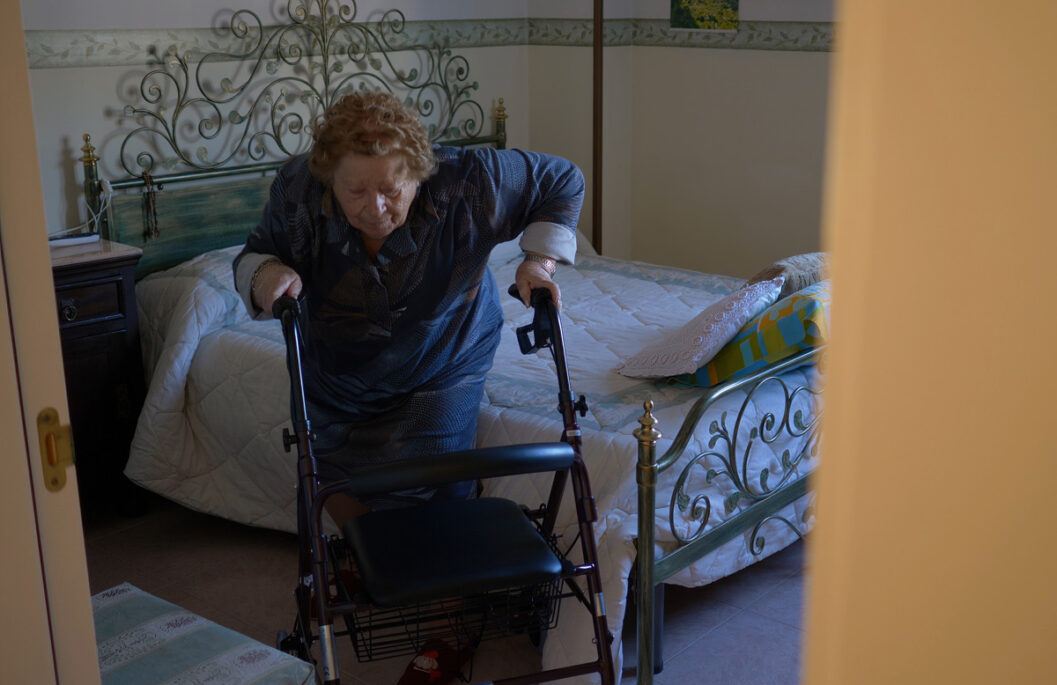
- Familiarity and comfort — Home is where your loved one’s memories live, where routines are established, where everything is in its place. This matters enormously for older adults and especially for those with dementia, for whom environmental consistency reduces confusion and distress
- Independence and autonomy — In-home care allows people to set their own schedules, eat what they choose, receive visitors on their own terms, and continue the rhythms of their daily life
- One-on-one attention — In-home caregivers are dedicated to a single client. In a nursing home, one aide may be responsible for eight or more residents
- Family proximity — It is generally easier for family members to visit and participate in care when the loved one is at home
- Pets, routines, and personal space — In-home care allows your loved one to keep their pet, maintain their garden, watch their preferred television programs, and sleep in their own bed
The Case for Nursing Home Care — What It Provides
- Medical safety and supervision — For people with complex medical needs, a nursing home’s 24-hour nursing presence is genuinely safer than what can be provided in a home environment, even with professional in-home care
- Social engagement — Isolation is a serious health risk for older adults. Quality nursing homes provide a built-in social environment — shared meals, group activities, peer relationships — that in-home care cannot replicate
- Consistent staffing — A nursing home’s operational structure means care doesn’t depend on a single caregiver showing up. Backup coverage is built in
- Relief for family caregivers — Nursing home placement is not abandonment. For exhausted family caregivers, it can restore the relationship — allowing family members to visit as loved ones rather than as care managers
- Specialized programming — Memory care units, rehabilitation gyms, therapy pools, chaplain services, and structured activities are available in ways that in-home care simply cannot provide
Signs That In-Home Care May Be the Better Fit
In-home care is typically the better fit when:
- Your loved one is medically stable and does not require around-the-clock skilled nursing supervision
- Care needs are moderate — personal care, companionship, medication management, or a few skilled home health visits per week — rather than intensive
- Your loved one has strong, expressed preferences about remaining at home — and those preferences can be honored safely
- The home environment is safe or can be made safe with reasonable modifications
- Family support is available to supplement professional care — someone who can be a backup, help monitor, and stay engaged in care coordination
- The financial picture supports in-home care at the needed intensity, or Medicaid HCBS waiver coverage is available
- The goal is rehabilitation and return to independence — in-home care combined with skilled home health can often support recovery from surgery, stroke, or illness without a nursing home stay
Browse Senioridy’s in-home care directory to find licensed agencies near you, and our home health medical directory for Medicare-certified skilled home health providers.
Signs That a Nursing Home May Be the Better Fit
A skilled nursing home is typically the better fit when:
- Medical complexity requires licensed nursing supervision that cannot be safely replicated at home — complex wound care, IV therapy, frequent clinical monitoring, or unstable medical conditions
- Your loved one needs care approaching or at 24 hours per day, and the cost of in-home care at that intensity exceeds what the family can sustain
- Dementia has progressed to the point where behavioral symptoms — aggression, severe agitation, wandering — cannot be safely managed in a home environment
- The primary family caregiver’s health, relationships, or quality of life are suffering seriously — caregiver burnout is a legitimate reason to consider a higher level of care
- The home environment cannot be made safe — structural barriers, geographic isolation, or lack of available local in-home care services
- Social isolation at home is a serious concern and the person would benefit from the built-in community of a facility setting
- Your loved one qualifies for Medicaid nursing home coverage and the financial picture makes long-term in-home care unsustainable
Search Senioridy’s skilled nursing home directory to find and compare facilities near you. For those needing short-term rehab following a hospitalization, our SNF short-term rehab directory lists facilities focused on recovery and return home.
The Middle Ground: Options Between Home and Nursing Home
For many families, the choice is not binary. Several care settings fall between in-home care and a skilled nursing facility, and they deserve consideration before a nursing home decision is made.
- Assisted living — Residential communities that provide personal care assistance, meals, activities, and 24-hour staffing oversight — but not skilled nursing care. A good fit for those who need more support than in-home care provides but less than a nursing home. Browse assisted living communities on Senioridy.
- Memory care communities — Specialized residential settings for those with Alzheimer’s or other dementias — secure environments, dementia-trained staff, and structured programming. Search memory care near you.
- Adult day programs — Structured daytime care in a community setting that provides social engagement, activities, meals, and supervision for people who need support during the day while family caregivers work or rest. Not residential, but a valuable supplement to in-home care.
- Continuing care retirement communities (CCRCs) — Communities that offer independent living, assisted living, and skilled nursing on the same campus — allowing residents to access a higher level of care as needs change without moving to a different community.
- Hospice care at home or in a facility — For those with a terminal diagnosis who choose comfort-focused care, hospice is available in the home, in an assisted living community, or in a nursing home. Learn more in our hospice care guide.

A Decision Framework for Your Family
Rather than asking “which is better?” — a question with no universal answer — the right question is: “which is better for our loved one, at this stage of their illness, with our family’s resources and circumstances?” Here is a framework for thinking it through:
Step 1: Assess Current and Anticipated Care Needs
- How many hours of care per day does your loved one realistically need right now?
- How complex are their medical needs — do they require daily skilled nursing, or primarily personal care and supervision?
- How rapidly are needs expected to progress? A condition that will require nursing-level care within six months calls for different planning than one likely to be stable for several years
- Is there a primary diagnosis driving the care need — dementia, Parkinson’s, heart failure, post-surgical recovery — and what is the typical trajectory?
Step 2: Understand the Financial Picture Honestly
- What is the current monthly cost of the care your loved one needs — in both settings?
- Does your loved one have long-term care insurance, VA benefits, or Medicaid coverage that applies?
- At what level of care does the cost of in-home care exceed the cost of a nursing home in your local market?
- What is the realistic financial runway — how many months or years can the family sustain the chosen option?
Step 3: Factor In Your Loved One’s Preferences
- Has your loved one expressed clear preferences about where they want to be cared for?
- Can those preferences be honored safely at the level of care they need?
- If they cannot express preferences due to cognitive impairment, what did they say when they could — and what does the advance directive say?
Step 4: Assess the Family Caregiver Situation
- Is there a family caregiver who can realistically supplement professional in-home care — and is that person’s health and wellbeing sustainable?
- Is caregiver burnout already present — or approaching? This is a legitimate factor, not a selfish one
- Do family members live nearby, or is the care situation being managed from a distance?
Step 5: Consult the Right Professionals
- Your loved one’s primary care physician — for an honest assessment of medical needs and likely trajectory
- Your local Area Agency on Aging — for information about local programs, Medicaid eligibility, and community resources
- A licensed elder law attorney or Certified Medicaid Planner — for guidance on Medicaid eligibility, asset planning, and long-term care financing
- Your SHIP counselor — for clarity on what Medicare will and won’t cover in each setting
The Bottom Line
There is no universally right answer between in-home care and a nursing home — only the answer that is right for your loved one, your family, and your circumstances at this particular moment. What matters most is making the decision with accurate information, honest assessment of needs, and genuine respect for your loved one’s wishes and dignity.
Most families find that the right choice evolves over time. In-home care may be the right answer today, with a nursing home or assisted living becoming the right answer two years from now. Building a care plan that anticipates this possibility — rather than treating the current arrangement as permanent — is one of the most practical things a family can do.
Senioridy’s directory is designed to help you navigate all of these options in one place. Browse in-home care agencies, skilled nursing homes, assisted living, memory care, and hospice care — all searchable by location, all with direct provider contact. And if you’re working through the broader care planning process, our step-by-step guide to creating a care plan for aging parents is a helpful place to start.
This article is for informational purposes only and does not constitute legal, financial, or medical advice. Cost figures are 2026 estimates based on regional agency and facility market benchmarks and vary by location, care type, and provider. Medicare coverage rules, SNF coinsurance amounts, and Medicaid eligibility requirements are updated annually and vary by state — confirm current figures at Medicare.gov or with your State Health Insurance Assistance Program (SHIP) counselor at shiphelp.org. Medicare Advantage (Part C) plan coverage varies — verify your specific plan’s benefits before making care decisions. Medicaid nursing home eligibility and spend-down rules are state-specific and complex — consult a licensed elder law attorney or Certified Medicaid Planner for guidance. Always confirm current requirements with official program representatives and your loved one’s physician.