
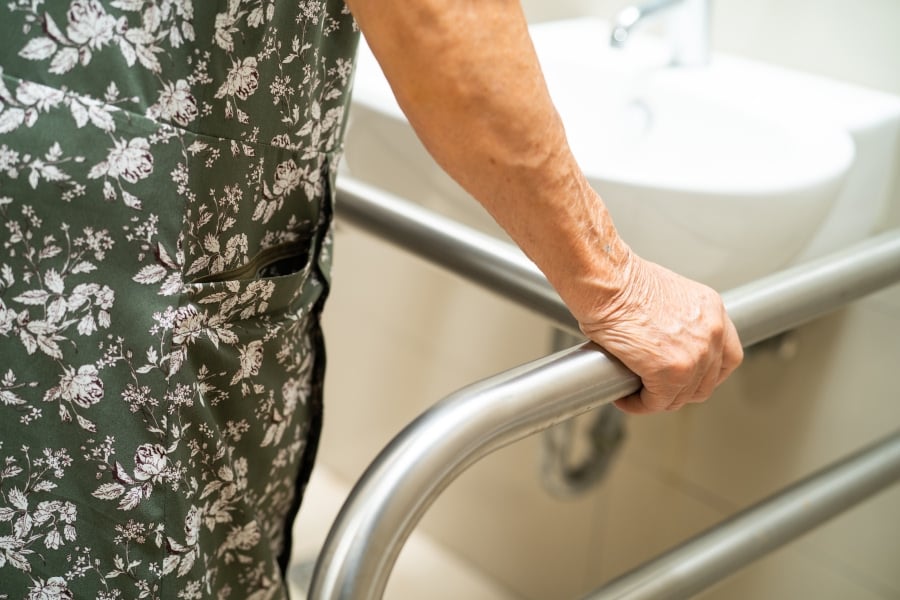
Most families know what home modifications would help their aging loved one stay safe and independent — a walk-in shower, grab bars, a ramp at the front door, better lighting. The challenge is rarely figuring out what to do. It’s figuring out how to pay for it. The good news is that more financial help exists than most families realize: federal loan and grant programs, VA benefits for eligible veterans, potential tax deductions, and local programs through Area Agencies on Aging and state governments. This guide walks through the most important grants for home modifications, federal programs, and funding sources available in 2026 — so families can stop waiting and start making the changes that keep their loved one safely at home.
What Types of Home Modifications Can Be Funded?
Before exploring funding sources, it helps to understand what types of modifications most programs will cover. Our complete room-by-room home safety modification guide covers the full range of options in detail. Most funding programs prioritize modifications that improve health, safety, and accessibility, including:
- Bathroom safety — grab bars, roll-in showers, walk-in tubs, raised toilet seats, non-slip flooring
- Accessibility and mobility — wheelchair ramps, widened doorways, stair lifts, threshold ramps
- Fall prevention — improved lighting, handrails, elimination of trip hazards
- Structural repairs — roof, plumbing, electrical, and HVAC systems that affect health and safety
- Kitchen and living area modifications — lowered countertops, lever door handles, accessible storage
- Health hazard removal — lead paint abatement, mold remediation, heating system repair
Cosmetic upgrades — new paint, flooring, landscaping for aesthetic purposes — are generally not covered by grant or loan programs. The closer a modification is to a health, safety, or medical need, the better the chances of finding financial support for it.
Federal Programs for Home Modification Funding
HUD Title I Property Improvement Loan Program
The HUD Title I Property Improvement Loan Program is one of the most widely available and underused federal resources for home modifications. HUD insures loans made by private lenders — which means families who might not qualify for conventional financing can still access funds for critical home improvements.
- Loan amounts: Up to $25,000 for a single-family home
- No home equity required — unlike a home equity loan, you do not need to have built up equity in your home to qualify
- Fixed interest rate — negotiated between the lender and borrower, generally based on prevailing market rates
- Loans under $7,500 are unsecured — no lien on the property required
- Loans over $7,500 must be secured by a mortgage or deed of trust on the property
- Eligible uses include accessibility modifications, structural repairs, energy efficiency improvements, and other improvements that enhance the safety or livability of the home
- To find a HUD-approved Title I lender, contact HUD at 800-767-7468 or search HUD’s lender list online
Title I loans are not grants — they must be repaid — but the terms are generally more accessible than conventional home improvement loans, making them a practical option for families who need to borrow to fund modifications.

USDA Section 504 Home Repair Loans and Grants — For Rural Homeowners
The USDA Section 504 Home Repair Program — also called the Single Family Housing Repair Loans and Grants program — is one of the few federal programs that offers outright grants (money that does not need to be repaid) for home modifications. It is specifically for very-low-income homeowners in eligible rural areas.
- Loans: Up to $40,000 at a fixed 1% interest rate, repaid over 20 years — available to very-low-income rural homeowners of any age
- Grants: Up to $10,000 — available only to homeowners age 62 or older who cannot repay a loan; grants do not need to be repaid as long as the homeowner remains in the home for at least 3 years
- Combined assistance: Loans and grants can be combined for up to $50,000 in total assistance
- Income requirement: Household income must be at or below 50% of the Area Median Income (AMI) for the county
- Property requirement: The home must be in a USDA-eligible rural area — generally communities with populations under 35,000. Use the USDA eligibility map at rd.usda.gov to verify
- Eligible uses: Health and safety hazard removal, accessibility modifications, structural repairs, and home modernization
- Applications are submitted through your local USDA Rural Development office
For families in rural areas with limited income — particularly those with a senior who is 62 or older — the Section 504 grant component is one of the most meaningful funding sources available. It is worth applying for even if the full grant amount isn’t needed.
CDBG — Community Development Block Grants
The HUD Community Development Block Grant (CDBG) program provides flexible federal funding to states, cities, and counties, a portion of which many communities direct toward low-to-moderate income homeowner assistance — including home repair and accessibility modification programs.
- CDBG funds are distributed to local governments, which design and administer their own programs — meaning eligibility requirements, benefit amounts, and available modifications vary significantly by location
- Some communities offer grants, others offer low-interest loans or deferred loans that are forgiven if the homeowner stays in the home for a set number of years
- Contact your city or county’s housing department — or your local Area Agency on Aging — to find out what CDBG-funded programs are available in your area
- CDBG programs are often income-restricted, typically serving households at or below 80% of Area Median Income
CDBG is often the “hidden” local funding source that families never hear about until they ask. It’s worth a call to your local housing department or Area Agency on Aging specifically to ask what home repair or modification assistance they administer.
VA Housing Grants for Veterans — Significant Benefits Many Families Miss
North Carolina has one of the largest veteran populations in the country — and the same is true across much of the South and Midwest. If your loved one is a veteran with a service-connected disability, the VA’s disability housing grant programs represent some of the most generous home modification funding available anywhere. These are grants — not loans — and they do not need to be repaid.
Specially Adapted Housing (SAH) Grant
- Maximum amount: Up to $126,526 for FY 2026 (adjusted annually based on construction cost index)
- For veterans with severe permanent service-connected disabilities — including loss or loss of use of both legs, loss of one leg and one arm, blindness in both eyes, or certain severe burns
- Can be used to build a new accessible home, purchase an accessible home, or extensively modify an existing home
- Can be used up to 6 times over a veteran’s lifetime, as long as the total does not exceed the maximum
Special Housing Adaptation (SHA) Grant
- Maximum amount: Up to $25,350 for FY 2026
- For veterans with qualifying service-connected disabilities including blindness in both eyes, loss of use of both hands, or certain severe burn injuries
- Used for targeted modifications — widened doorways, ramps, accessible bathrooms, adapted kitchens
- Can also be used up to 6 times up to the maximum amount
Home Improvements and Structural Alterations (HISA) Grant
- Maximum amount: Up to $6,800 lifetime for veterans with service-connected disabilities; up to $2,000 for veterans without a service-connected disability
- Unique in that it is available even for non-service-connected disabilities — making it accessible to a broader group of veterans
- Covers medically necessary improvements — grab bars, roll-in showers, ramps, widened doorways
- Requires a prescription from a VA physician documenting the medical necessity of the modification
- Apply using VA Form 10-0103 through the Prosthetics Service at your VA medical center
Temporary Residence Adaptation (TRA) Grant
- For SAH-eligible veterans: up to $50,961 for FY 2026
- For SHA-eligible veterans: up to $9,100 for FY 2026
- Used to modify a family member’s home where the veteran is temporarily residing — useful during transitions or when the veteran’s own home is being modified
To apply for SAH or SHA grants, complete VA Form 26-4555 and submit it online through va.gov, by mail to a VA Regional Loan Center, or in person at a VA office. A VA Specially Adapted Housing agent will be assigned to guide the process. Contact the VA at 1-800-827-1000 for assistance.
Medicaid Home and Community-Based Services (HCBS) Waivers
Many states include home modification assistance as a covered service under their Medicaid Home and Community-Based Services (HCBS) waiver programs. These waivers are designed to help elderly and disabled individuals remain in their homes rather than entering a nursing facility — and home modifications that support that goal may be covered.
- Coverage varies significantly by state — some states cover modifications up to several thousand dollars per year; others have more limited programs
- Common covered modifications include ramps, grab bars, bathroom safety equipment, and other accessibility improvements
- The individual must be enrolled in Medicaid and meet the functional eligibility criteria for the waiver program in their state
- Waitlists exist in many states — this is not a rapid funding source for families in immediate need, but worth applying for as part of a longer-term plan
- Contact your state’s Medicaid office or local Area Agency on Aging for information on what HCBS waiver programs are available and what modifications they cover
State, Local, and Nonprofit Programs
Beyond federal programs, a wide range of state and local resources may be available depending on where your loved one lives. These are often the best-kept secrets in home modification funding — and they’re worth asking about directly.
Area Agencies on Aging
Your local Area Agency on Aging (AAA) is the single best starting point for finding local home modification programs. AAAs administer or know about nearly every program available in their county — including programs funded by the Older Americans Act, state appropriations, and community grants that never appear in a national search. Many AAAs operate their own home repair and modification programs for income-eligible seniors.
- Call your local AAA or use the Eldercare Locator to find the one serving your zip code
- Ask specifically: “Do you have a home repair or home modification program for seniors?” — and ask whether there are waitlists and how to get on them
- AAAs can also connect families with volunteer programs — such as Rebuilding Together or local Habitat for Humanity affiliates — that may complete modifications at no cost
State Housing Finance Agencies
Most states have a housing finance agency that administers home repair and rehabilitation programs for low-to-moderate income homeowners. Programs vary widely but may include low-interest loans, deferred loans, or grants specifically for accessibility modifications and health and safety improvements. Search for your state’s housing finance agency online or ask your local AAA for a referral.
Nonprofit and Community Programs
- Rebuilding Together — a national nonprofit with local affiliates that provide free home repairs and modifications for low-income homeowners, with a focus on elderly and disabled residents. Find your local chapter at rebuildingtogether.org
- Habitat for Humanity — many local Habitat affiliates offer a “Home Preservation” or “Aging in Place” program that provides low or no-cost repairs and modifications for income-qualified homeowners
- Local community foundations — many communities have foundations that fund accessibility and senior housing programs; your AAA or United Way can point you toward local options
- Utility company programs — many electric and gas utilities offer weatherization or energy efficiency programs that may overlap with home safety improvements. Ask your utility provider what assistance programs they offer for seniors or low-income customers
Tax Deductions for Home Modifications
Some home modifications may qualify as medical expense deductions on federal income taxes under IRS Publication 502. This is not a grant or a loan — it’s a potential reduction in your tax liability if you itemize deductions. Because tax situations vary significantly, always consult a qualified tax professional before making decisions based on deductibility.
How It Works
- The IRS allows taxpayers to deduct unreimbursed medical expenses that exceed 7.5% of their adjusted gross income (AGI) when they itemize deductions
- Medically necessary home modifications — modifications made primarily for medical reasons related to a disability or chronic condition — may qualify as medical expenses under IRS Publication 502
- Qualifying modifications include wheelchair ramps, grab bars, widened doorways, roll-in showers, stair lifts, and similar accessibility improvements
- If a modification increases the market value of the home, only the portion of the cost that exceeds the increase in value is deductible — for example, if a $15,000 bathroom modification increases home value by $8,000, the deductible portion would be $7,000
- Modifications that do not increase home value — such as grab bars or threshold ramps — may be fully deductible as medical expenses, subject to the 7.5% AGI threshold
Important Considerations
- You must itemize deductions to claim this benefit — given the current standard deduction amounts, itemizing makes sense only when your total itemized deductions exceed the standard deduction for your filing status
- The modification must be primarily for medical reasons — not general home improvement — and you should document the medical necessity with a physician’s recommendation
- This deduction applies to the year the modification is completed and paid for
- A qualified tax professional can help you determine whether itemizing makes sense for your situation and how to document home modification costs correctly
Other Ways to Finance Home Modifications
When grants and programs aren’t available or don’t cover the full cost of needed modifications, families have additional financing options worth considering:
Home Equity Loan or HELOC
Homeowners with equity in their home may be able to access it through a home equity loan (a fixed loan against the equity) or a home equity line of credit (HELOC — a revolving credit line). Interest rates are typically lower than personal loans or credit cards, and interest may be tax-deductible in some circumstances. Consult a financial advisor or tax professional for guidance specific to your situation.
Home Equity Conversion Mortgage (HECM) — Reverse Mortgage
For homeowners age 62 or older, a HUD-insured reverse mortgage (HECM) allows homeowners to convert a portion of their home equity into funds — without monthly mortgage payments — that can be used for home modifications, living expenses, or other needs. Reverse mortgages are complex financial products with significant implications for estate planning and home ownership. Families considering this option should speak with a HUD-approved reverse mortgage counselor before proceeding.

Long-Term Care Insurance
Some long-term care insurance policies include a benefit for home modifications related to care needs. Review your policy carefully — or ask your insurance agent directly — to understand what home modification benefits, if any, are included.
Personal Loans and Contractor Financing
For smaller modifications, some families use personal loans or contractor financing programs. These typically carry higher interest rates than secured options but may be practical for lower-cost projects like grab bars, threshold ramps, or improved lighting.
Where to Start: A Practical Action Plan
The range of programs can feel overwhelming — but the search doesn’t have to be. Here’s a practical starting sequence:
- Step 1: Call your local Area Agency on Aging (find it at eldercare.acl.gov) and ask what home repair and modification programs they administer or know about in your county. This single call often surfaces local programs that aren’t findable online.
- Step 2: If your loved one is a veteran with a service-connected disability, contact the VA at 1-800-827-1000 or visit va.gov/housing-assistance/disability-housing-grants/ before exploring any other funding source. VA grants are among the most generous available and should be pursued first.
- Step 3: If the home is in a rural area and household income is low, apply for the USDA Section 504 program through your local USDA Rural Development office — especially if your loved one is 62 or older and may qualify for the grant component.
- Step 4: Contact your city or county’s housing department and ask about CDBG-funded home repair programs or any local homeowner assistance programs for seniors.
- Step 5: Explore HUD Title I loans through a HUD-approved lender if grant programs are unavailable or insufficient to cover the full cost.
- Step 6: Consult a qualified tax professional about whether your modifications may qualify as a medical expense deduction under IRS Publication 502.
- Step 7: Check usa.gov/home-repair-programs for a current summary of federal home repair assistance programs and links to additional state resources.

Key Resources at a Glance
Here is a quick reference to the primary resources covered in this article:
- Find your local Area Agency on Aging: eldercare.acl.gov
- HUD Title I Property Improvement Loans: hud.gov/program_offices/housing/sfh/title
- USDA Section 504 Home Repair Loans and Grants (rural): rd.usda.gov — Single Family Housing Repair
- HUD CDBG local programs — contact your city or county housing department, or search: hud.gov/program_offices/comm_planning/cdbg
- VA Disability Housing Grants (SAH, SHA, HISA, TRA): va.gov/housing-assistance/disability-housing-grants
- Federal home repair program overview: usa.gov/home-repair-programs
- IRS Publication 502 — Medical and Dental Expenses (home modification deductibility): irs.gov/publications/p502
- HUD reverse mortgage (HECM) counselor locator: hud.gov/hecm
- Free Medicare and benefits guidance — SHIP: shiphelp.org
The Bottom Line
The cost of home modifications should not be what stands between a senior and the ability to stay safely in their home. Federal programs, VA benefits, state and local resources, and potential tax deductions can all contribute to making critical modifications affordable — but finding and applying for these programs takes time and initiative. Starting with your local Area Agency on Aging is almost always the right first move.
For families also exploring whether in-home care, assisted living, or other senior care options might be the right fit alongside — or instead of — home modifications, Senioridy’s directory covers in-home care providers, assisted living communities, memory care, and low-income senior housing — all searchable by location. And our complete guide to aging in place covers the full picture of what it takes to support a loved one’s independence at home.
This article is for informational purposes only and does not constitute legal, financial, tax, or medical advice. Program eligibility requirements, funding amounts, and availability vary by location and are subject to change. VA grant amounts reflect FY 2026 figures from the U.S. Department of Veterans Affairs and are adjusted annually. USDA Section 504 loan and grant limits are based on current USDA Rural Development program information and are subject to change. Tax deductibility of home modifications depends on individual circumstances including income, filing status, and medical necessity — always consult a qualified tax professional before making tax-related decisions. Reverse mortgages are complex financial products — consult a HUD-approved housing counselor before proceeding. Always confirm current program eligibility and funding availability with the administering agency or a licensed professional.