
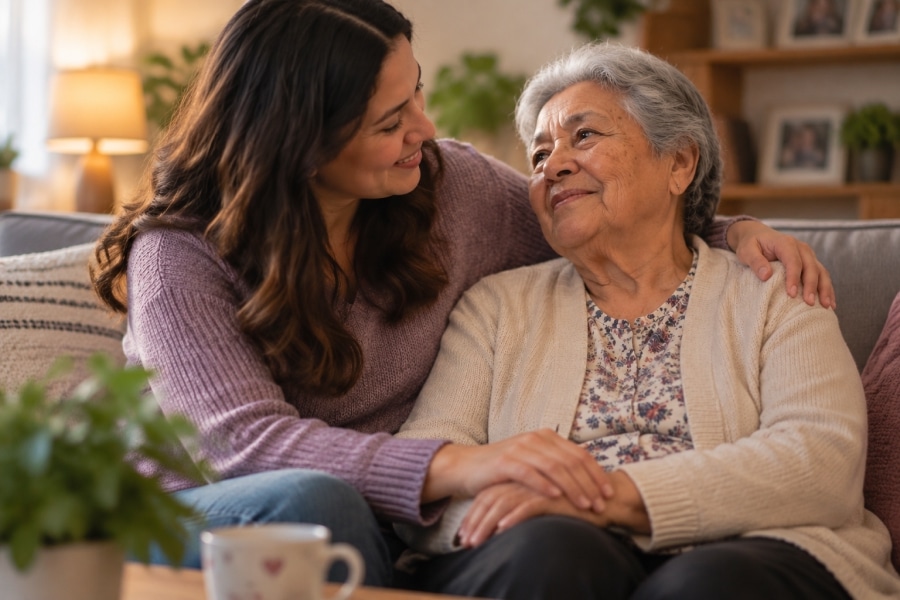
Caring for a loved one through hospice asks a great deal of a family. What many families don’t realize is how much support is already built into that experience, both while hospice care is happening and in the months after a loved one dies. This guide looks at the people on a hospice team who are there for caregivers, not just patients, what happens to that support after death, and where to turn for grief and caregiver support along the way.
The Quiet That Follows
One daughter spent the better part of a year caring for her father at home during hospice. Her days had settled into a rhythm: medication times, the hospice nurse’s Tuesday visits, the small routines that come with caregiving. Then he was gone, and so, almost overnight, was the rhythm. The hospital bed was picked up. The nurse stopped coming. She found herself standing in a suddenly quiet house, unsure what to do with a Tuesday afternoon that no longer had a visit to prepare for.
Caregivers often describe this same disorientation: relief that a loved one is no longer suffering, tangled up with grief, exhaustion, and a strange sense of purposelessness once the caregiving itself ends. None of that is unusual, and none of it is something families have to sort through alone.
Support That’s Already Part of Hospice Care
Families sometimes think of hospice as care for the patient alone. In practice, a Medicare-certified hospice team is built to support the whole family, and that support doesn’t wait until after a death. According to Medicare’s official hospice benefits guide, a hospice plan of care can include social worker services along with grief and loss counseling for the patient’s family, available throughout the course of care, not only afterward.
The Hospice Social Worker
- Talks with caregivers about the emotional and practical weight of the caregiving role, not just the patient’s needs.
- Helps connect families to community resources, from respite options to financial assistance programs.
- Can assist with paperwork like advance directives and help coordinate with other agencies a family may already be working with.
The Hospice Chaplain
- Offers spiritual and emotional support that isn’t tied to a specific religion or denomination, and can work alongside a family’s own clergy or faith community if they prefer.
- Is generally available to caregivers as well as patients, for conversations about meaning, fear, or the practical questions that come with an approaching death.
- Can often help with funeral or memorial planning when a family wants that kind of support.
If a caregiver feels like they’re carrying too much alone during hospice, asking the team for more support from a social worker or chaplain, or for more frequent visits, is a normal and reasonable request. That’s part of what the hospice benefit is there for.


What Happens to Support After a Loved One Dies
One of the most overlooked pieces of the Medicare hospice benefit is what happens after death. Under the hospice Conditions of Participation set by the Centers for Medicare & Medicaid Services (CMS), Medicare-certified hospices are required to make bereavement services available to a patient’s family for up to 13 months following the death.
- This support generally isn’t limited to whoever was the primary caregiver. Close family members, and in many hospice programs close friends as well, can be included.
- What bereavement support looks like varies by hospice program, but it often includes some mix of phone check-ins, mailed materials on grief, invitations to memorial or remembrance services, individual counseling, and grief support groups.
- Families usually don’t need to ask to start receiving this support. Most hospice programs reach out on their own in the weeks after a death. If that outreach hasn’t happened, or a family needs more than what’s been offered, contacting the hospice program directly is a reasonable next step.
- This bereavement benefit is separate from, and doesn’t add cost to, the hospice care already provided. Some individual counseling may fall under a family member’s own health coverage rather than the hospice benefit itself, so it’s worth asking the hospice program what’s included at no charge.
What Grief After Hospice Can Look Like
Grief after a loved one’s death, especially after a long stretch of caregiving, doesn’t follow a predictable pattern. According to the National Institute on Aging (NIA), grief can bring both physical and emotional symptoms, including trouble sleeping, little interest in food, and difficulty concentrating, and it commonly includes feelings that catch families off guard, like relief, guilt, or occasional anger.
- There’s no set timeline for grief, and no single “right” way to move through it.
- Feeling relief that a loved one’s suffering has ended, alongside sorrow, is a common and normal combination, not something to feel guilty about.
- Good days and difficult days will likely keep showing up for a while, and that’s part of the process rather than a sign something is wrong.
For some caregivers, grief settles gradually. For others, especially those who spent months or years in an intense caregiving role, the adjustment can take longer and feel heavier. If grief is making it hard to manage daily responsibilities over an extended period, talking with a doctor or a licensed mental health professional is a reasonable and often helpful step, not a sign of failure. Anyone who needs to talk to someone right away can reach the 988 Suicide & Crisis Lifeline by call or text, at any hour.

Finding Grief and Caregiver Support
- Start with the hospice program that cared for your loved one. Most offer free bereavement services for a year or more, and many open that support to the wider community, not only the families they served directly.
- A local Area Agency on Aging, found through the Eldercare Locator, can point families toward grief support groups, caregiver support groups, and other community resources nearby.
- Caregiver Action Network, the nation’s largest family caregiver organization, publishes resources written specifically for caregivers navigating loss after a caregiving role ends.
- Faith communities often run their own grief support groups or can connect a family with a chaplain, even for families who weren’t especially active in a congregation before.
- Many hospitals, community mental health centers, and local libraries also host free or low-cost grief support groups open to the public.
Support Doesn’t End When Caregiving Does
Caregiving through hospice is some of the hardest work a family will ever do, and it doesn’t stop mattering the moment it’s over. The same hospice team that supported a loved one’s final months, including the chaplain, the social worker, and the wider bereavement program, is generally still available to the people who cared for them. For a broader look at what day-to-day hospice care involves, see Hospice Care: What Families Need to Know, and for families weighing hospice care at home specifically, Hospice at Home: A Practical Guide for Family Caregivers covers what that day-to-day experience tends to look like.
Our hospice care directory can help families find hospice providers in their area.
This article is for informational purposes only and does not constitute legal, financial, or medical advice. Hospice bereavement benefits and the specific services offered are subject to change and can vary by hospice program; confirm current offerings directly with your hospice provider. Medicare Advantage (Part C) plans may have different hospice benefit rules and networks than Original Medicare, so it’s worth verifying your specific plan’s coverage. For free, personalized Medicare guidance, contact your State Health Insurance Assistance Program (SHIP) counselor at shiphelp.org, available in every state at no cost. If grief, caregiving stress, or a loved one’s illness is affecting your daily life, consider talking with your doctor or a licensed mental health professional.