
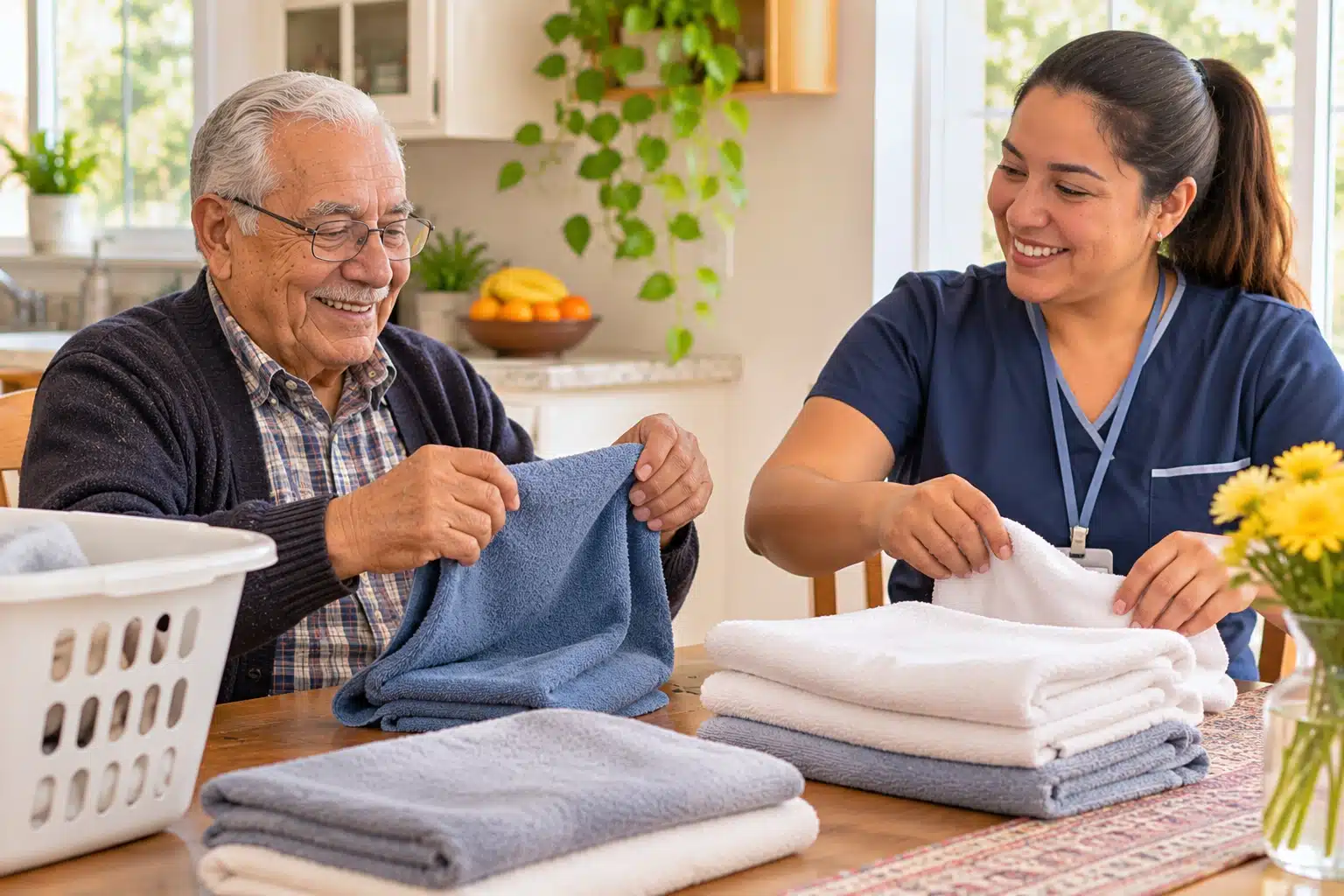
Nobody grows up dreaming of the day they can finally stop vacuuming. But for a lot of older adults, chores that used to take an afternoon start taking all week, and the laundry basket quietly becomes a permanent piece of furniture. Homemaker services fill that gap with practical help around the house for seniors who still manage their own personal care but could use a hand with everything else. This guide covers what homemaker services typically include, where they stop, what they cost, and the programs that may help pay for them.
When the House Starts Telling the Story
Picture a daughter who drops by on a Sunday and notices her dad’s kitchen looks a little different. Nothing dramatic. A few dishes that have clearly been soaking for a while, more expired items in the refrigerator than fresh ones, a stack of unopened mail on the counter. Her father is showering, dressing, and getting around just fine. He admits, a bit embarrassed, that standing at the sink for long stretches wears him out, and carrying laundry down the basement stairs makes him nervous.
He doesn’t need a caregiver to help him bathe or dress. He needs a few hours of help a week with the house. That’s exactly the situation homemaker services are built for, and it’s often one of the first kinds of outside help families bring in. Treating early signs like these as useful information, rather than a crisis, can take pressure off a parent’s energy and safety, and off the adult children who have been quietly doing the dishes on every visit.
What Are Homemaker Services?
Homemaker services are non-medical, in-home help with household tasks. Care professionals often call these instrumental activities of daily living (IADLs), the everyday tasks that keep a household running, such as cleaning, cooking, shopping, and laundry. They’re different from activities of daily living (ADLs), the personal tasks like bathing, dressing, and using the bathroom.

Here’s how homemaker services generally compare with other types of in-home help:
- Homemaker services: help with the house, such as light cleaning, laundry, meals, and errands, without hands-on personal care.
- Companion care: conversation, supervision, and social connection, often with some light household help mixed in.
- Personal care: hands-on help with ADLs such as bathing, dressing, and toileting, usually with household tasks included. Our guide to personal care assistance for seniors covers what it includes and what it costs.
- Home health care: skilled medical care, such as nursing or therapy, ordered by a doctor and often covered by Medicare for people who qualify.
In practice, the lines blur. Many agencies bundle homemaker and companion tasks into one service, and the U.S. Bureau of Labor Statistics (BLS) notes that personal care aides are generally limited to nonmedical services such as companionship, cleaning, cooking, and driving. Because labels vary from one agency or program to the next, asking for a written task list tends to be more useful than relying on the service name. Our guides to personal care vs. companion care and home health vs. home care explain those neighboring levels of care in more detail.
What Homemaker Services Typically Include
Light Housekeeping
- Dusting, vacuuming, sweeping, and mopping the main living areas.
- Cleaning the kitchen and bathroom, including counters, sinks, and the tub or shower.
- Washing dishes and loading or unloading the dishwasher.
- Taking out the trash and recycling.
- Changing bed linens.
Laundry
- Washing, drying, folding, and putting away clothes and towels.
- Light ironing or simple mending, depending on the provider.
Meals and Groceries
- Planning simple meals, including meals that fit a diet a doctor has recommended.
- Cooking during the visit or prepping food for the days in between.
- Grocery shopping, with or without the senior coming along.
- Clearing out expired food so the refrigerator stays safe to use.
Errands and Household Routines
- Picking up prescriptions, dry cleaning, or household supplies.
- Sorting mail and keeping an appointment calendar where it’s easy to see.
- Basic pet care, such as feeding or a short walk, where the agency allows it.
- Keeping walkways inside the home clear of clutter, which can help lower tripping hazards.
Exact tasks vary by agency, by state rules, and by whichever program is paying for the service. A care plan or service agreement typically spells out what’s included.

What Homemaker Services Usually Don’t Include
- Hands-on personal care. Bathing, dressing, toileting, and help moving from a bed to a chair usually fall under personal care, which typically costs more.
- Medical tasks. Wound care, injections, and managing medications belong to nurses or to home health aides working under a care plan. Some homemakers can give simple medication reminders, depending on state rules.
- Heavy chores. Deep cleaning, moving furniture, yard work, gutter cleaning, and home repairs are often called chore services and may be offered separately, if at all.
- Large clean-outs. Sorting through decades of belongings is usually its own project rather than routine homemaking. Our guide to deciding what to keep can help families approach that work.
Signs a Parent Might Benefit From Homemaker Help
- Dishes, laundry, or trash piling up between family visits.
- Spoiled food in the refrigerator, or meals being skipped because cooking feels like too much.
- Unopened mail or bills that slip past their due dates.
- Avoiding the stairs to the laundry room, or avoiding the kitchen because standing is tiring.
- A home that’s noticeably less tidy than a parent would have accepted a few years ago.
- A family caregiver who’s handling the household on top of a job and their own family.
If the signs include trouble bathing, dressing, or moving around safely, a higher level of care may be a better fit. Our article on when aging in place no longer works walks through those bigger signals.

What Homemaker Services Cost
There’s no single national price for homemaker services, and cost depends heavily on where a parent lives. A helpful starting point is what the workers themselves earn. According to the federal Bureau of Labor Statistics, home health and personal care aides, the occupation group that includes most in-home homemakers, earned a median of $17.21 an hour in May 2025.
Agency rates are typically higher than the caregiver’s wage, since the agency also covers payroll taxes, insurance, background checks, training, scheduling, and backup coverage when a regular caregiver is out. Our national guide to in-home care costs by state shows how caregiver wages differ from one state to the next.
What Shapes the Bill
- Location. Rates generally follow local wages and state or city minimum wage laws.
- Visit minimums. Many agencies set a minimum visit length, often two to four hours, which matters for families who only want an hour or two of help.
- Schedule. Evenings, weekends, and holidays may cost more.
- Agency vs. private hire. Hiring an individual directly often costs less per hour, but the family usually takes on the employer role, which can include household employment taxes. Our guide to hiring a private caregiver or a home care agency covers those tradeoffs.
- Bundled services. If a parent also needs companion or personal care, the hourly rate typically reflects that higher level of care.
An Illustrative Example
These numbers are illustrative, not quotes, but they show how a modest schedule adds up:
- At an agency rate of $30 an hour, two 3-hour visits a week come to $180 a week, or roughly $780 a month.
- The same schedule at $25 an hour comes to $150 a week, or roughly $650 a month.
Calling two or three local agencies and asking for their hourly rate, visit minimum, and task list tends to give the most accurate picture for a specific area.
Ways to Help Pay for Homemaker Services
Most families pay privately for homemaker services, but several programs may cover some or all of the cost, especially for older adults with limited income or growing care needs. Our guide on how to pay for in-home care looks at these options side by side.
Medicare
- Original Medicare generally doesn’t pay for homemaker services on their own. Medicare.gov lists homemaker services, like shopping and cleaning, that are unrelated to a care plan among the things Medicare doesn’t cover.
- When someone qualifies for Medicare home health care, an aide may help with some light household tasks as part of a visit tied to the care plan, but that isn’t the same as ongoing homemaker help.
- Some Medicare Advantage plans offer in-home support as a supplemental benefit. What’s covered varies widely by plan, and CMS tightened the rules for some of these benefits in 2026, so the plan’s Evidence of Coverage or member services line is the best place to confirm. Our guide to Medicare Advantage senior care coverage explains how these extra benefits work.
- A State Health Insurance Assistance Program (SHIP) counselor can review Medicare options at no cost.
Medicaid Home and Community-Based Services
- Medicaid home and community-based services (HCBS) waivers let states pay for long-term care at home instead of in a nursing home. Medicaid.gov lists homemaker services among the standard services states can offer through these waivers.
- Waivers are generally designed for people whose care needs would otherwise call for a nursing home, so an assessment is typically part of applying.
- Eligibility rules and covered services vary by state, and states can cap how many people a waiver serves, so some programs keep waiting lists.
- Our guide to Medicaid long-term care waivers for in-home care covers how these programs work. Because Medicaid rules are complex, families may want to talk with a licensed elder law attorney or a Certified Medicaid Planner about their specific situation.
Older Americans Act Services Through the Area Agency on Aging
- The Older Americans Act funds in-home services, including homemaker help, personal care, and chore assistance, through the Administration for Community Living’s supportive services program. Funding flows to states and then to local Area Agencies on Aging (AAAs).
- These programs are aimed at adults 60 and older and don’t use Medicaid-style income tests, though many ask for a voluntary contribution and some use a sliding scale. Funding is limited, so what’s available varies by area.
- Our guide to what an Area Agency on Aging does explains how to work with your local office. To find it, use the Eldercare Locator or call 1-800-677-1116.
VA Homemaker and Home Health Aide Care
- The VA’s Homemaker and Home Health Aide program sends a trained aide, supervised by a registered nurse, to help enrolled veterans with daily activities, including grocery shopping as well as personal care.
- Enrolled veterans may qualify if they’re eligible for community care, meet the program’s clinical criteria, and the service is available in their area. A copay may apply depending on service-connected disability status.
- A VA social worker is the usual starting point. Our guide to VA home care benefits covers this program alongside Aid and Attendance.
Long-Term Care Insurance and Family Arrangements
- Some long-term care insurance policies cover homemaker services once the policy’s benefit triggers are met. Terms differ widely, so a licensed insurance professional or the insurer can confirm what a specific policy includes.
- Some families pay a relative to handle household help. Our guide to paying a family member to be a caregiver covers programs that may help.

Questions to Ask a Homemaker Provider
- What tasks are included, and what’s off the list?
- Is there a minimum visit length or a minimum number of hours per week?
- Are caregivers employees of the agency, and are they background-checked, bonded, and insured?
- Will the same caregiver come each time, and who fills in when they’re out?
- How do services change if a parent later needs personal care?
- Does the agency accept Medicaid waiver, VA, or long-term care insurance payment?
Common Questions Families Ask
Is a homemaker the same as a cleaning service?
Not quite. A cleaning service focuses on the house. A homemaker focuses on the person living in it, mixing light cleaning with meals, errands, and a friendly check-in, usually on a regular schedule with the same caregiver. Many families find that consistency matters as much as the clean kitchen.
Can homemaker services be the only help a parent gets?
For many seniors who handle their own personal care, a few hours a week of homemaker help is enough to keep the household running smoothly. Needs often change over time, and many agencies can add companion or personal care later without switching providers.
How many hours do most families start with?
There’s no standard. Families often start small, such as one or two visits a week, and adjust once they see how it goes. An agency’s visit minimum usually sets the floor.
Finding Homemaker Help Near You
Homemaker services are often the gentlest first step into in-home care. They take the heaviest household chores off a parent’s plate while leaving independence and daily routines intact, and they give the whole family a chance to see how outside help fits before needs grow. When you’re ready to compare options, you can find in-home care providers near your parent’s home in Senioridy’s directory.
This article is for informational purposes only and does not constitute legal, financial, or medical advice. Wage figures, care costs, and program rules described here are subject to change, and Medicaid waiver and Older Americans Act services vary by state and local area. Medicare Advantage plans may offer benefits that differ from Original Medicare, so check a specific plan’s coverage directly. For free, personalized Medicare guidance, contact your State Health Insurance Assistance Program (SHIP) counselor, available in every state at no cost. For Medicaid eligibility questions, consider a licensed elder law attorney or Certified Medicaid Planner; for household employment taxes, a qualified tax professional; and for long-term care insurance, a licensed insurance professional. Always confirm current requirements with official program representatives.